
What "Brain Rot" Actually Describes
The term entered popular use to describe the subjective experience of mental deterioration from excessive digital consumption: the inability to focus on anything longer than 90 seconds, the flattening of imaginative capacity, the creeping sense that your brain is less sharp than it used to be.
Oxford's Word of the Year 2024 defined it as "the supposed deterioration of a person's mental or intellectual state as a result of overconsumption of material — now particularly online content considered to be of low quality or value."
The "supposed" is doing a lot of work there. Because the research suggests this isn't imagined.
The Clinical Version Has a Name
In 2012, German neuroscientist Manfred Spitzer coined the term Digital Dementia — describing the pattern of cognitive changes associated with chronic digital overuse. His research suggested that heavy reliance on digital devices for memory, navigation, and information processing was causing measurable changes in how the brain organises and retrieves information.
The features overlap considerably with what the internet calls brain rot:
- Difficulty sustaining attention on tasks requiring deep focus
- Reduced short-term and working memory capacity
- Increasing dependence on external prompts and notifications
- Mental fatigue disproportionate to actual workload
This isn't unique to Singapore — but Singapore's combination of extremely high smartphone penetration, long office hours, and one of the world's most connected digital environments makes it a particularly fertile ground for these patterns.
The Piece Nobody Is Talking About
Here is where the brain rot conversation falls short: it focuses almost entirely on what you're consuming. But there is a physical dimension to digital cognitive decline that most people — including most health professionals — are missing.
Your brain does not operate in isolation from your body. And one of the most underappreciated relationships in human physiology is the one between your spine and your brain.
Approximately 40% of the stimulation your cerebellum receives comes from proprioceptive input. The cerebellum — the part of the brain responsible for coordination, balance, timing, and a range of higher cognitive functions — depends on your body's ongoing sense of its own position in space. And the spine, along with the postural muscles that support it, is one of the richest sources of proprioceptive input in the entire body.
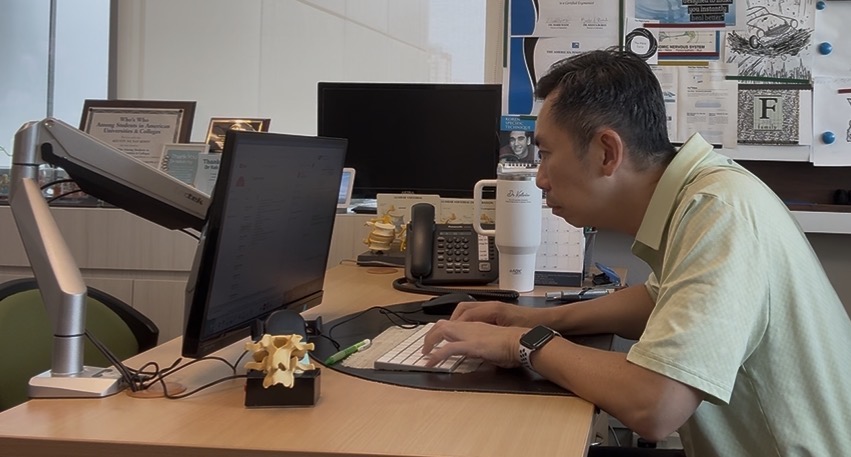
When you slump over a screen in forward head posture for hours at a time, you are not only loading your cervical spine with the mechanical equivalent of 40–60 lbs of extra weight. You are also dramatically reducing the quantity and quality of proprioceptive signals reaching your brain.
Less spinal movement. Less postural muscle activation. Less cerebellar stimulation. The brain, receiving less input, functions less well.
The Suboccipital Region: A Key You've Never Heard Of
There is a specific structural concern worth understanding in more detail.
The region where the cervical spine meets the base of the skull — the suboccipital area — is uniquely dense in proprioceptive nerve endings. Researchers have found that the suboccipital muscles contain three to five times more muscle spindles per gram of tissue than most other muscles in the body. This region acts as a primary sensory relay station between the body and the brain.
Forward head posture chronically compresses and shortens this area. The suboccipital muscles become tight and hypertonic. The proprioceptive signalling that normally flows freely from this region — a rich stream of information feeding into the brain — becomes distorted and reduced.
Clinically, I regularly see patients presenting with brain fog, difficulty concentrating, and disproportionate fatigue — alongside forward head posture. When the structural issue is addressed through chiropractic care and targeted postural rehabilitation, many patients report cognitive improvements alongside the physical ones. From a neurological standpoint, this makes sense: restoring normal segmental movement to the cervical spine restores more normal proprioceptive output. The brain receives better input. It functions better.
Why Singapore Is Particularly Exposed
Three converging factors make Singapore's population especially vulnerable:
Screen time. Singapore consistently ranks among the world's highest for average daily smartphone use. Many professionals are in front of screens — phone, laptop, second monitor — for 10 or more hours a day.
Sedentary work culture. Long office hours in largely fixed positions mean the spine is loaded in the same compromised posture for extended periods, with minimal movement breaks.
Indoor, air-conditioned environments. Singapore's heat discourages outdoor movement, which is among the most effective sources of varied proprioceptive input. Walking on uneven ground, for instance, generates rich spinal and cerebellar stimulation that sitting in an office chair simply cannot replicate.
The result: a population whose brains are simultaneously receiving less varied physical input and more passive, low-demand digital content — a combination that does not favour cognitive sharpness.
What You Can Actually Do
The fix is not to abandon your phone. It is to address both dimensions of the problem: the content habits and the physical ones.
On the Physical Side
- Movement breaks every 30–45 minutes. Even 2–3 minutes of standing, walking, or simple movement generates proprioceptive input and breaks the pattern of sustained spinal loading. Set a timer if you need to — most people discover they have been sitting for 90 minutes without realising.
- Chin tucks. 10 repetitions, 5-second holds, done several times a day. This reactivates the deep cervical flexors, counters forward head posture, and begins to restore more normal loading to the suboccipital region. Simple, but clinically effective when done consistently.
- Raise your screen. The top of your monitor should be at eye level. If you are looking down at a laptop screen for hours a day, the physics of cervical spine loading are working against you regardless of how many exercises you do.
- Get your spine assessed. If forward head posture has been present for months or years, self-directed exercises address the symptoms without correcting the underlying structural changes. A clinical assessment identifies specific vertebral fixations and addresses them directly — something no app or exercise programme can substitute for.
On the Cognitive Side
- Replace some passive consumption with active engagement — reading that requires comprehension, tasks that require planning, conversations that require listening. The brain builds what it uses.
- Boredom is productive. Unstructured mental time is when the brain consolidates learning and restores attentional capacity. The instinct to fill every idle moment with a phone is working against your cognitive health.
- Sleep matters more than most people account for. Cognitive consolidation happens during deep sleep. Poor sleep hygiene compounds the effects of everything else on this list.
The Bottom Line
Brain rot is real. Its causes are partly about what you consume, and partly about what happens to your body — and specifically your spine — while you consume it.
Most people address the content side and ignore the physical one. But the spine-brain relationship is one of the most clinically significant and publicly underappreciated connections in human health. The posture you hold while scrolling is actively affecting how well your brain works — and addressing that physical component is not optional extra credit. It is half the solution.
Get a Posture & Spine Assessment
If you're experiencing brain fog, concentration difficulties, or fatigue alongside neck stiffness or poor posture, a clinical assessment is the most direct way to understand what's contributing — and what to do about it.
Book via WhatsApp Send an Email